
Think about how drastically your business landscape has changed in recent years.
Now, imagine that pace accelerating even further.
As we approach 2025, we’re not just witnessing change – we’re experiencing a fundamental transformation that’s reshaping the very foundations of how businesses operate and succeed.
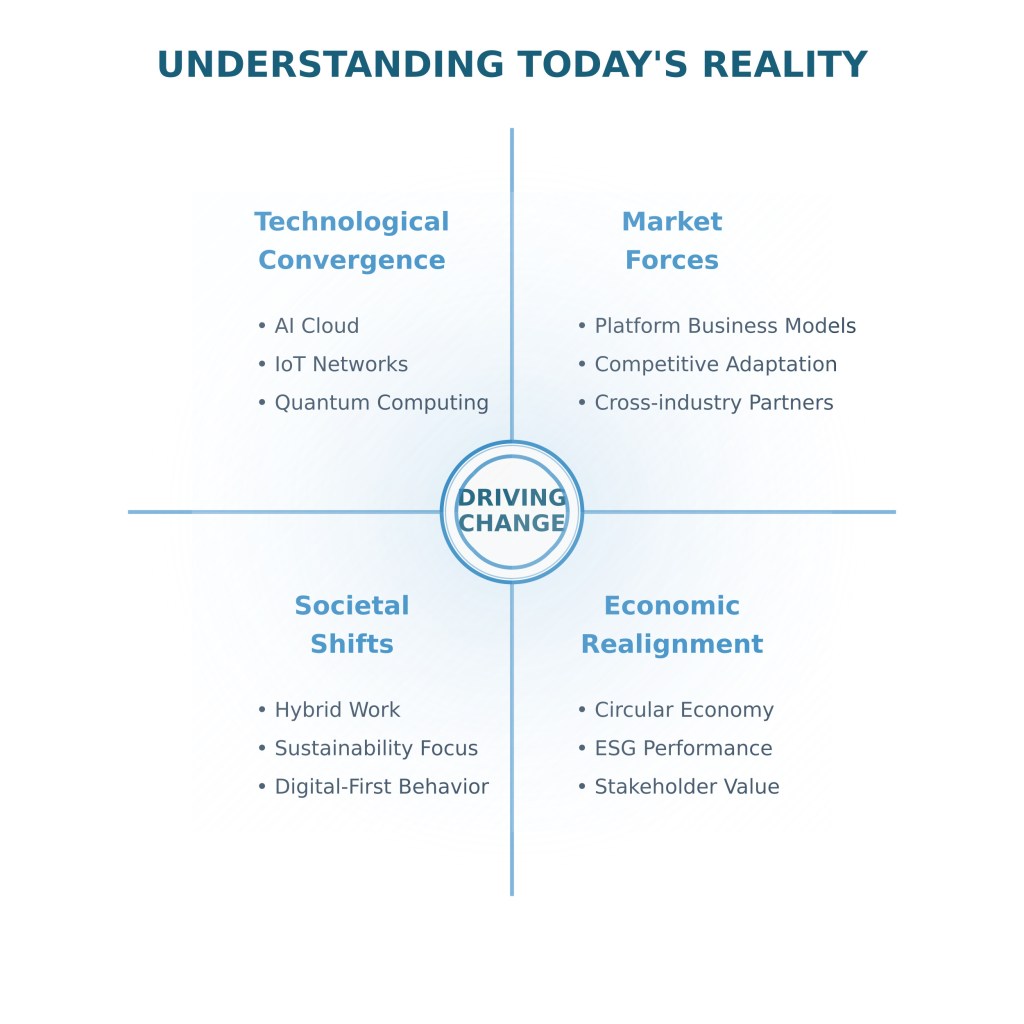
Understanding Today’s Reality
The transformation surrounding us isn’t happening in isolation. It’s the result of four powerful forces converging in ways we’ve never seen before. Let’s explore what’s really driving this change:
1. Technological Convergence
Remember when AI was just a buzzword? Today, it’s driving real business outcomes.
Recent research indicates that AI can enhance efficiency by about 10% to 25% subject to the specific use case and implementation strategies used by different organisations.
But it’s not just about AI:
- Cloud computing has become integral to agile operations, with over 90% of enterprises utilising cloud services to some extent, and approximately 74% of large enterprises relying heavily on cloud infrastructure.
- IoT networks are generating unprecedented insights, with over 27 billion connected devices expected to share real-time data by 2025.
- Quantum computing is moving from research labs to real-world applications, promising to solve previously impossible challenges.
2. Market Forces
The rules of competition have fundamentally changed.
Consider this:
- Six of today’s top ten most valuable companies operate platform business models.
- 76% of executives report that their business model must change to remain competitive, with many taking significant actions to adapt in response to market pressures.
- Cross-industry partnerships have increased significantly since 2020, with reports indicating a rise of around 17% to 65% depending on the sector and specific metrics used.
3. Societal Shifts
The way we work and consume has undergone a permanent transformation:
- 85% of employees now prefer a hybrid work model.
- Sustainability isn’t just nice-to-have – 73% of consumers actively consider environmental impact in their purchases.
- Digital-first behaviour has become so ingrained that 68% of consumers expect seamless experiences across all channels.
4. Economic Realignment
Traditional business metrics are no longer enough:
- Circular economy initiatives have shown to reduce costs by up to 40%.
- Companies with strong ESG performance command an average 10% premium in market value.
- Stakeholder capitalism has led to 47% better long-term value creation.
The Three Critical Shifts: Your Path Forward
Understanding these forces is one thing. Knowing how to respond is another.
Here are three critical shifts, in my opinion, successful organisations are making right now. These aren’t theoretical concepts – they’re practical transformations that leading companies are implementing today.
Shift 1: Digital Acceleration – Beyond the Basics
Remember when having a website was considered “digital transformation”?
Those days are long gone.
Today’s digital acceleration is about fundamentally reimagining how technology can create and deliver value.
This isn’t about keeping up – it’s about leaping ahead.
What’s Really Happening?
Leaders in digital acceleration aren’t just implementing technology – they’re reinventing their businesses around it.
Take Starbucks, for example. Their digital transformation wasn’t just about mobile ordering; it was about creating an entirely new customer experience.
The result? Over 31% of their transactions now happen through digital channels, contributing to $36.18 billion in revenue.
Key Elements of Modern Digital Acceleration:
Intelligence Integration
- AI isn’t just automating tasks – it’s augmenting decision-making at every level.
- Advanced analytics are moving from descriptive (what happened?) to prescriptive (what should we do?).
- Machine learning is creating personalised experiences at scale.
Cloud-Native Operations
- Think beyond cloud storage to cloud-native business processes.
- Real-time scalability that matches customer demands.
- Integration that makes technology invisible to users.
Experience Engineering
- Seamless interactions across all touchpoints.
- Predictive engagement that anticipates needs.
- Trust-based relationships built on digital foundations.
Making It Work
The difference between success and failure often lies in approach.
Organisations implementing comprehensive digital strategies can see productivity gains of up to 70%, as evidenced by companies in the World Economic Forum’s Global Lighthouse Network.
Productivity gains are those that:
- Start with customer needs, not technology capabilities.
- Build digital fluency across their entire workforce.
- Measure impact in business outcomes, not technical metrics.
Shift 2: Sustainable Business Practice Integration – Making Purpose Profitable
Sustainability has moved from a corporate social responsibility initiative to a core business driver. This shift isn’t just about doing good – it’s about doing good business.
The New Business Imperative
A report from Nielsen noted that 66% of consumers are willing to pay more for sustainable products, sustainability becomes a market force you can’t ignore.
But here’s what’s interesting: organisations leading in sustainability aren’t just responding to consumer demands – they’re discovering entirely new business opportunities.
Three Dimensions of Sustainable Integration:
Operational Excellence
- Energy efficiency programmes delivering 15-30% cost savings.
- Waste reduction creating new revenue streams.
- Resource optimisation driving innovation.
Market Leadership
- Sustainable products growing 5.6x faster than conventional alternatives.
- Brand value enhancement through authentic sustainability stories.
- New market opportunities in the circular economy.
Stakeholder Engagement
- Employee satisfaction up 55% in sustainability-focused companies.
- Investor confidence strengthened through ESG performance.
- Community relationships building long-term business resilience.
Critical Success Factors
The organisations seeing the greatest returns are those that:
- Embed sustainability in their core strategy, not as an add-on.
- Create measurable impacts, not just aspirational goals.
- Build sustainability into their innovation process.
Shift 3: Workforce Evolution – The Human Element of Transformation
The way we work isn’t just changing – it’s being reinvented. This shift goes beyond remote work to fundamentally rethink how we organise, motivate, and empower people.
The New World of Work
Organisations with inclusive cultures are 1.7 times more innovative. But what’s truly fascinating is how the definition of “workplace” and “workforce” is evolving.
Core Elements of Workforce Evolution:
Flexible Work Models
- Hybrid arrangements boosting productivity by 25%.
- Asynchronous collaboration becoming the norm.
- Location-independent talent strategies.
Cultural Transformation
- Inclusive practices driving better decision-making.
- Purpose-aligned teams showing 3x higher engagement.
- Leadership styles adapting to distributed teams.
Digital Collaboration
- Tools enabling new forms of creativity.
- Virtual spaces fostering real connections.
- Technology supporting human interaction, not replacing it.
Keys to Success
Leading organisations are:
- Building cultures that embrace change.
- Developing new management capabilities.
- Creating environments where all voices are heard.
Here’s the thing.
We stand at a pivotal moment where technology, sustainability, and human potential converge. The most successful organisations are no longer just adapting to change—they’re actively reshaping the boundaries of what’s possible.
Our competitive edge lies in our ability to integrate intelligent technologies, embrace sustainable practices, and create workforce models that unlock human creativity.
This is more than a picture of what the most successful business looks like. It is the fundamental truth that reveals how technology amplifies human potential, sustainability fuels innovation, and purpose defines performance.
We’re not just adapting to a new business environment—we’re actively constructing a more intelligent, responsive future.
The future belongs to those who can see beyond traditional boundaries, who understand that true innovation emerges when we align technological capability with human insight.
In an era of unprecedented change, our greatest competitive advantage is our collective capacity to reimagine, reinvent, and relentlessly pursue meaningful progress—transforming challenges into opportunities, and vision into reality.
Become the architects of what’s possible.
 andrewkklee.com
Leave a comment