

In the ever-accelerating whirlwind of 2023, the digital realm continues to undergo rapid transformation unbated unlike any other.
From the astonishing advances in artificial intelligence (AI), Internet of Things (IoT) to the revolutionary potential of blockchain, this year has been nothing short of unprecedented revolutionary wave of technological innovations.
As we venture into the final quarter, it’s clear that the pace of digital technology innovation is unstoppable, leaving human intuition struggling to keep up with exhilarating changes sweeping across industries.
What’s Driving the Change?
“Your life does not get better by chance, it gets better by change.”
Jim Rohn
Digital technology evolves exponentially, demanding businesses to adapt or face fierce competition. The fact is, technological advances and innovation directly impact business success.
When companies are starting to think about their digital transformation journey, it’s not just about adopting new digital technology, but also about changing the way an individual company operates, interacts, and innovates.
Beneath the surface of the evolving deep-seated culture change required, lies three fundamental laws sharing a commonality – exponential growth.
These three laws are processing power, communication speed, and storage capacity.
In this article, we’ll delve into these three fundamental laws, understand their significance in driving digital transformation, and how leveraging on digital technology has visible impact on business performance.
THE 3-FUNDAMENTAL LAWS.
1. The Law of Processing Power
Processing power, often associated with Moore’s Law, has been a driving force behind digital transformation for decades.
Coined by Intel co-founder Gordon Moore in 1965, this law predicts that the number of transistors on a microchip will double approximately every two years. As a result, we’ve witnessed a relentless increase in computing power.
Today, AI algorithms can process massive datasets in real-time, enabling businesses to make data-driven decisions with unprecedented speed and accuracy.
To put into context the exponential growth of processing power that has paved the way for innovations such as artificial intelligence (AI), machine learning, and advanced data analytics, is a result in the quantum leap of processing power over the past decades.
The standard measurement of computer processing power known as MIPS (million instructions per second) metric, indicates how many instructions a computer can execute in a second.
In 1965, the IBM System/360 Model 91 had a peak performance of about 16.6 MIPS.
In contrast, in 2023, the Apple M1 chip has a peak performance of about 15,000 MIPS. This means that the processing power of the Apple M1 chip is about 903 times higher than that of the IBM System/360 Model 91.
To put this in perspective, if the IBM System/360 Model 91 could execute one instruction in a second, the Apple M1 chip could execute 903 instructions in the same time.
This is a significant increase in computing power over the span of almost six decades.
As you can see, the processing power of computers has grown exponentially since 1965, following Moore’s Law.
Moreover, the law of processing power has made it feasible to deploy sophisticated applications in the cloud, which has become a cornerstone of digital transformation.
Companies can scale their operations seamlessly, tapping into vast computing resources as needed, without the burden of building and maintaining their own data centers.
2. The Law of Communication Speed
The second fundamental law driving digital transformation is the law of communication speed. Simply put, our ability to transmit data across networks has been accelerating at an exponential rate.
The advent of 5G technology is a prime example of this phenomenon.
With 5G, we’ve entered an era of ultra-fast, low-latency connectivity that has the potential to revolutionise industries like healthcare, autonomous vehicles, and the Internet of Things (IoT).
It enables real-time data exchange on an unprecedented scale, making remote surgeries, autonomous driving, and smart cities a reality.
Furthermore, the law of communication speed has fueled the rise of edge computing.
Though it’s an architecture rather a specific technology, edge computing allows the use of different devices and methods to achieve computing using sensors, cameras, smartphones, laptops, or edge servers to perform data processing at the edge of the network.
Let’s put into context of communication speed performance today using 5G technology.
For comparison, we use the example of downloading a MP3 song file about 4MB (megabytes) or 32 MB (megabits) using 5G technology today compared to the dawn of the Internet using the ARPANET in 1969.
It would take about 10 minutes and 40 seconds at 50 kbps to download one song file in 1969. With a 5G connection, with the 5G average download speed of about 200 Mbps, it would take only 0.16 seconds.
We can see that the difference in download speed between 5G and ARPANET is huge. A file that takes less than a second to download using 5G would take more than 10 minutes using Arpanet, that’s a factor of 4000 times faster!
Another simpler perspective for comparison is using the number of downloadable song files. Using the same context of the average download speed between 5G and ARPANET, we can download 256 songs in one minute over a 5G connection compared to only one song in 10 minutes and 40 seconds over the ARPANET in 1969. That’s a quantum leap!
The caveat here though is the 5G speed is subject to availability, variability, locality and quality of the 5G bandwidth.
By bringing computation and data storage closer to the source of data generation (e.g., IoT devices), businesses can process information locally, reducing latency and enhancing speed and responsiveness.
Hence, this architectural shift is redefining how applications are designed and deployed, opening new possibilities for innovation.
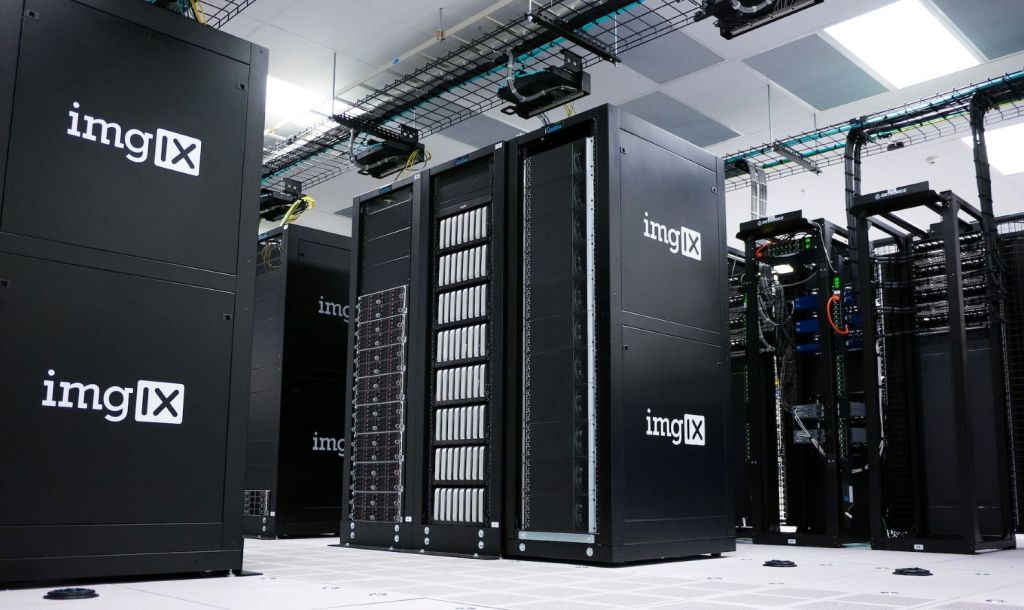
Photo credit: imgIX on Unsplash
3. The Law of Storage Capacity
Finally, the law of storage capacity has undergone a remarkable transformation.
We’ve moved from the days of floppy disks with kilobytes of storage to today’s era of terabyte, petabyte, and zettabyte-scale storage solutions today, and perhaps, exabyte and yottabyte-scale storage solutions in the future.
This exponential growth in storage capacity has empowered companies to collect and store vast amounts of data.
Big data and data lakes have become common parlance in the business world. This data serves as the lifeblood for analytics, insights, and AI-driven decision-making.
Moreover, advancements in storage technology, such as solid-state drives (SSDs) and 3D NAND flash memory, have not only increased capacity but also improved speed and reliability.
These innovations are crucial for managing the immense volumes of data generated by digital transformation initiatives.
We’ll skip the history of storage of times gone by, but we’ll use the first random-access storage invented in 1956 used by personal computers and servers as illustration.
A typical hard-disk drive in 1980 had a capacity of 5MB (megabytes) while a typical hard-disk drive in 2020 had a capacity of about 10 TB (terabytes).
As you can see, storage capacity has evolved from bits to zettabytes over the years, thanks to advances in technology and innovation.
The latest form of digital storage is the cloud storage, which was introduced in 2007 and used by computers and mobile devices.
Cloud storage is a service that stores data on remote servers that can be accessed over the internet.
Cloud storage has virtually unlimited capacity, depending on the provider and the plan.
There’re three key lessons as a takeaway.
First, we have learned that technology evolves fast, even faster than what the human intuition can capture.
The digital transformation landscape is shaped by the convergence of three fundamental laws growing in exponential speed – processing power, communication speed, and storage capacity.
Second, the impact these laws have on transaction cost is getting cheaper, and has disrupted the value chain across industries.
These laws, which all share the characteristic of explosive exponential growth, underpin the rapid evolution of digital technology and business practices in the digital age.
Finally, when embarking on a digital transformation journey, it’s crucial to have a long-term horizon in mind.
Despite the apparent paradox inference the immediate impact of technology innovation have on economic value creation, making the right technology investments have measurable impact on both revenue growth and profitability.
Previously, companies were vertically integrated to seek economies of scale. In the digital age, companies are structuring in stack-based architectures with multiple interoperable layers playing to the respective scale sensitivity and strength, while others fragmented with many niche players.
As we move further into 2023 and beyond, harnessing the potential of these laws will be paramount for companies to position themselves to gravitate towards internal deliberations, and crafting their own digital business strategy on their digital transformation journey.
 andrewkklee.com
Leave a comment